
Vea también


 13.10.2026 07:41 PM
The Elliott wave count on the 4-hour EUR/USD chart has become more complex. On the higher timeframe (lower chart), the downward trend segment has taken the form of a five-wave structure, A-B-C-D-E, which could be completed at any time, as it appears structurally complete. All the waves in this segment are approximately the same size, so I consider it corrective. If this assumption is correct, an impulsive upward trend segment will begin to form once it is complete, with targets well above the 20th level.
On the lower timeframe (upper chart), an impulsive wave sequence continues to develop, which may belong to wave E on the higher timeframe. If this is indeed the case, then regardless of how strongly the dollar rises, its strengthening is nearing an end. A fifth wave of the downward structure can be expected, as it appears impulsive. In any case, however, the current wave pattern suggests that the downward wave sequence is nearing completion on both charts. The news backdrop and the sharp shift in market sentiment have led to a strong rise in the US currency, but each day it becomes increasingly difficult for the dollar to continue rising.
The EUR/USD exchange rate rose by 40 basis points on Tuesday, a move that means little in the context of the euro's 500-basis-point decline over the past month. Today, the stars aligned, and the euro gained 0.4 cents. Tomorrow, the US inflation report will be released, and almost any reading could trigger renewed buying of the US currency. Therefore, today's 40-point gain has little significance.
After a month of uninterrupted declines in the euro, every attempt at recovery begins to look like a miracle. Even hypothetically, it is difficult to imagine what could now stop the downward trend and trigger an upward move. In other words, what kind of news backdrop could cause the euro to rise? An end to the conflict in the Middle East? An end to the conflict between Ukraine and Russia? An ECB rate hike of 2–3 percentage points at a single meeting? A collapse of the US economy? A collapse of the US stock market? An increase in US national debt to $50 trillion? Clearly, none of these scenarios has any realistic chance of materializing in the near future. The decline will therefore most likely end in an unremarkable way, without any obvious catalyst. It will happen on a day when nothing signals an impending reversal. Wednesday is unlikely to be that day.
US inflation will most likely accelerate, but even a weaker acceleration in consumer prices would not change market expectations for the Fed's monetary policy. Moreover, even the CME FedWatch indicator, which incorporates expectations for the following year, shows that the market currently expects no more than one policy tightening on average. Nevertheless, demand for the US currency continues to increase, leading to a straightforward conclusion: Fed policy has long ceased to be the reason for the dollar's appreciation. The global energy crisis continues to intensify, oil inventories are declining, and production and extraction are not increasing nearly fast enough to offset the shortfall following Kyiv's attacks on Russian oil refineries and the blockade of the Strait of Hormuz.
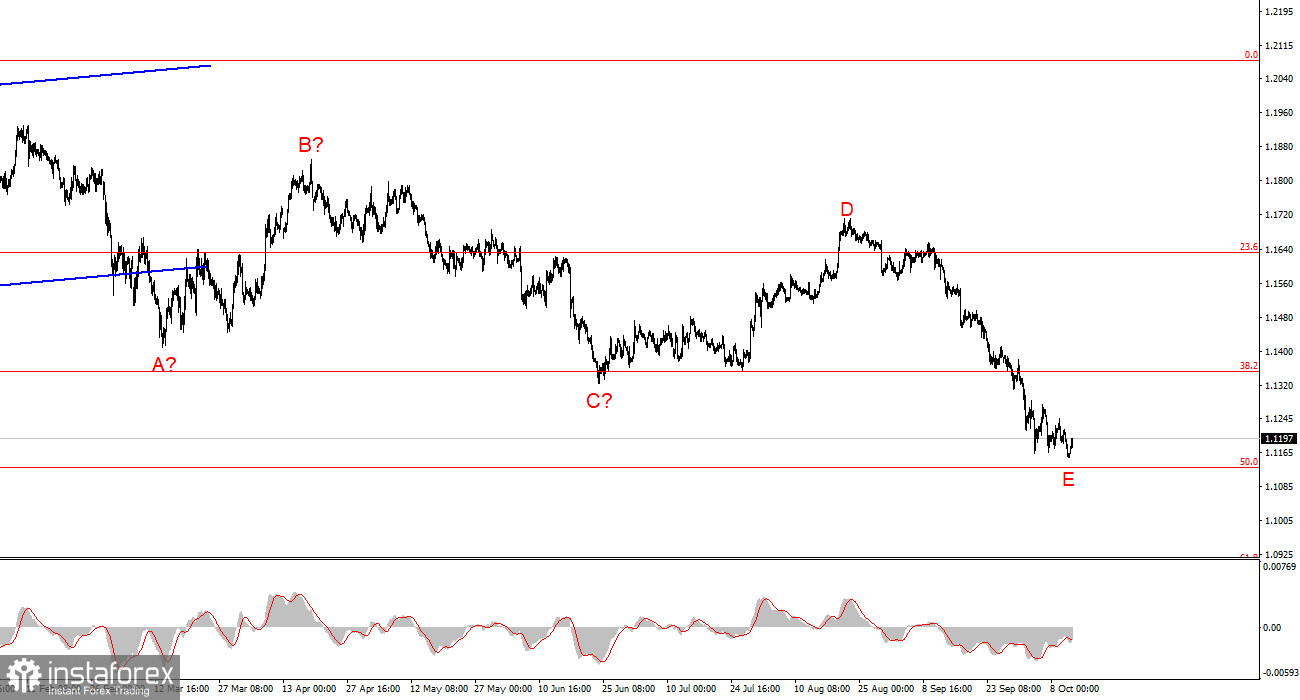
Based on my EUR/USD analysis, I conclude that the pair remains within a global corrective trend segment, A-B-C-D-E. If this assumption is correct, the decline will continue toward targets below the low of wave C at 1.1325. I considered this scenario an alternative, and if it had not been for the Fed meeting, it would have remained a secondary scenario. However, the Fed delivered a surprise, leaving the market with no alternative but to initiate another wave of US dollar buying. Yet buying has continued for several consecutive weeks, despite the absence of new supporting factors for the dollar. I would not open short positions in this news environment; instead, I would be preparing for a reversal.
On the higher timeframe, a downward trend segment is visible, taking the form of A-B-C-D-E. Consequently, EUR/USD may continue declining below the low of wave C, while the internal wave structure of wave E may develop into a five-wave impulsive pattern.
The Main Principles of My Analysis:


