
See also


 19.10.2026 08:42 AM
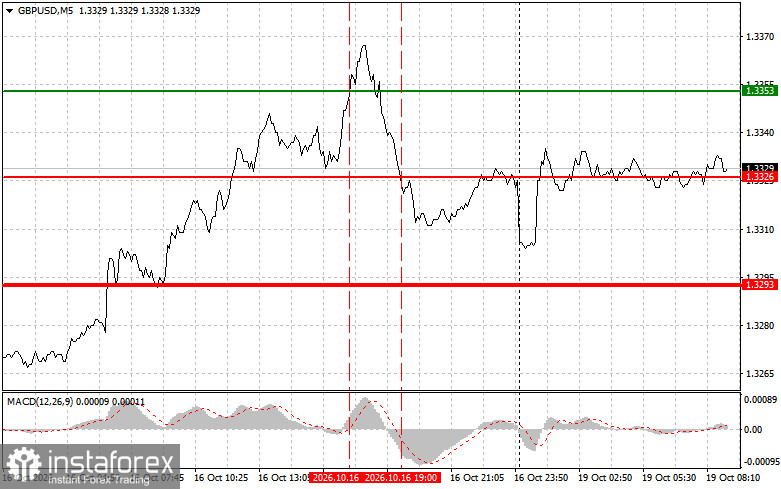
A price test at 1.3326 occurred after the MACD indicator had already moved far below the zero line, limiting the pair's downside potential. For that reason, I did not sell the pound.
Sterling started the week under pressure from a strong dollar. US industrial production rose 0.7% in September versus 0.4% expected (after only 0.1% in August). Utilities stood out with a 3.5% gain, and capacity utilization rose to 76.9% from 76.3% the prior month. That signals the US economy remains sufficiently tight for the Federal Reserve to keep a hawkish posture, supporting the dollar.
During the European session, the pound is trading after a sharp Asian sell-off but benefits from a quiet domestic calendar. No UK releases are due in the morning, so nothing prevents buyers from trying to reclaim lost ground. A pause in data often works in favor of a currency that has just fallen because the risk of fresh disappointments disappears. Without its own drivers, GBP/USD depends on external forces—chiefly the dollar and overall risk appetite. If demand for the dollar as a safe haven eases, the pound will have room to rise. Such rebounds after Asian sell-offs are common when the market judges the reasons for the drop to be short-lived.
For intraday strategy, I will mainly rely on Scenarios 1 and 2.
Scenario 1: Buy the pound today near 1.3340 (green line on the chart), targeting 1.3368 (thicker green line). I will exit long positions at 1.3368 and open short positions there, aiming for a 30–35 pip retracement. Expect pound gains today as a continuation of the trend. Important: Before buying, ensure MACD is above zero and just beginning to rise.
Scenario 2: Also consider buying if price tests 1.3320 twice while MACD is in the oversold area. That would limit downside potential and trigger a reversal higher. Expect moves to 1.3340 and 1.3368.
Scenario 1: Plan to sell the pound after a break below 1.3320 (red line). That should lead to a quick decline. Sellers' key target is 1.3293, where I will exit shorts and immediately open longs (aiming for a 20–25 pip reversal). Bad news would restore pressure on the pound. Important: before selling, ensure MACD is below zero and only beginning to fall.
Scenario 2: Also consider selling if price tests 1.3340 twice while MACD is in the overbought area. That would limit upside potential and trigger a downward reversal. Expect declines to 1.3320 and 1.3293.
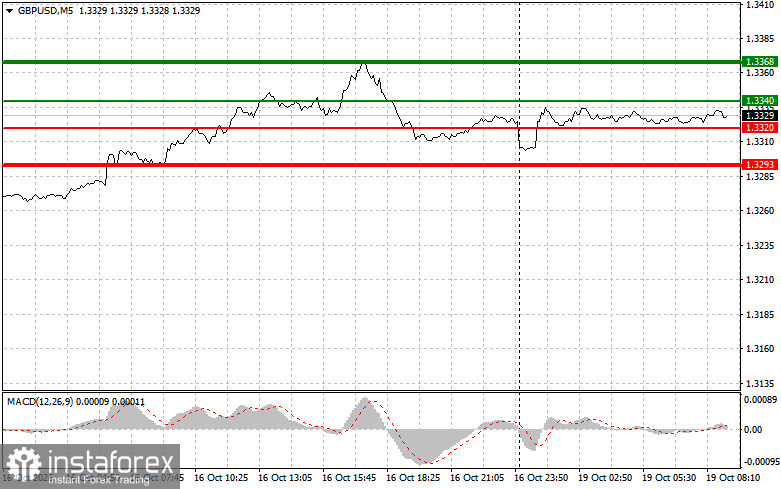
Thin green line — entry price where you can buy the instrument.
Thick green line — approximate price where you can place Take Profit or manually lock in profits, because further upside above this level is unlikely.
Thin red line — entry price where you can sell the instrument.
Thick red line — approximate price where you can place Take Profit or manually lock in profits, because further downside below this level is unlikely.
MACD indicator. When entering the market, it's important to consider overbought and oversold zones.
Important. Novice Forex traders must be very cautious when deciding to enter the market. It is best to stay out before major fundamental reports to avoid getting caught in sharp price swings. If you decide to trade during news releases, always place stop orders to minimize losses. Without stop orders, you can quickly lose your entire deposit, especially if you don't use money management and trade large volumes.
Remember: successful trading requires a clear trading plan, like the example above. Spontaneous trade decisions based solely on the immediate market situation are, by definition, a losing strategy for an intraday trader.


