
আরও দেখুন


 13.10.2026 07:41 PM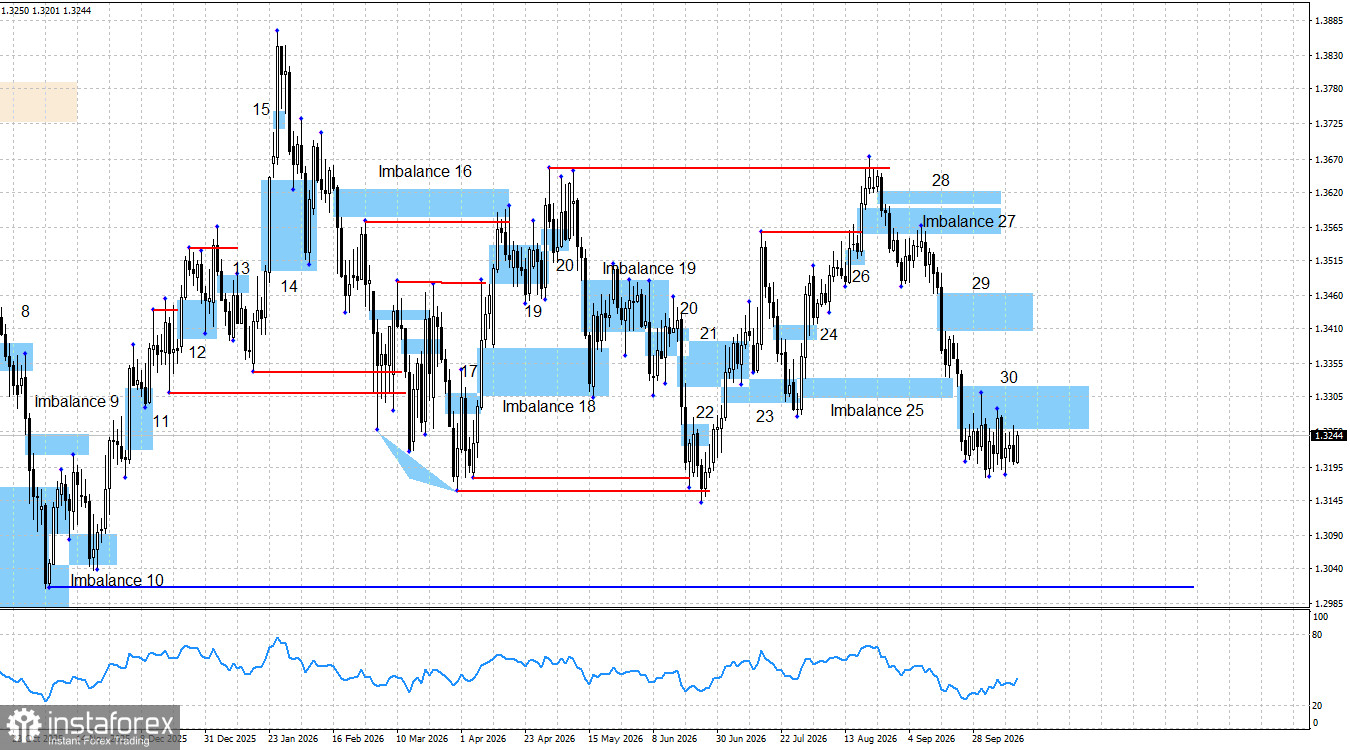
The GBP/USD pair was in a near-free fall for eleven days, but for the third consecutive week, bulls have been putting up desperate resistance against bears, preventing them from advancing further. Any corrective pullback is blocked by bearish Imbalance 30, which acts as a resistance zone. As a result, a local range has formed in the pound. Despite rising inflation in the UK, which reinforces the Bank of England's hawkish stance, despite a highly likely interest rate hike at the next meeting, and despite stronger-than-expected economic growth in the second quarter, bullish traders have not seen a single reason to launch an attack for more than a month. However, the pound's situation is less concerning than the euro's, which continues to decline. This week's US inflation report may even support the British pound, as virtually any September reading has already been priced in by the market through expectations for FOMC monetary policy. In other words, the market has already priced in at least one more rate hike in 2026, so the dollar has already gained on this factor regardless of the inflation reading. However, bulls need to launch an attack for the pair to rise. There is no other way.
It is worth noting that traders continue to expect two rounds of monetary policy tightening from the Bank of England, just as they do from the Fed. Once again, the dot plot actually points to only one policy tightening, while the latest FOMC minutes confirmed that most central bank policymakers expect just one rate hike. Of course, it is unclear what will happen in 2027, but this is the weighted-average forecast at present. Thus, the Bank of England may ultimately raise rates more aggressively than the Fed over the coming months, which clearly would not support further gains in the US dollar. Yet the pound cannot even manage a corrective pullback.
If the Fed had not decided to raise interest rates in September and signaled its readiness to continue tightening monetary policy, I would still expect the US dollar to decline. I still expect it to fall, but from lower levels. However, the bulls' chances now depend solely on a liquidity sweep of the lows from July 28 or June 24, as well as the formation of new bullish patterns, which require a confident upward move. The chart clearly shows that most reversals over the past year occurred after liquidity sweeps, so in my view, this is a good opportunity. The reaction to bearish Imbalance 30 has been weak so far, which may indicate that bearish momentum is fading. This could be an opportunity for the pound. A small one, but an opportunity nonetheless.
Do the bears have further downward potential? In my view, it is limited, but it must be acknowledged that the dollar remains in a favorable position and, until Imbalance 30 is invalidated, retains excellent prospects for further gains. Chart analysis shows that the picture remains entirely bearish following the liquidity sweep of the May highs. The pound reacted to bearish Imbalance 27, triggering a 320-point decline in the exchange rate. Now, bearish Imbalance 30 offers grounds for expecting a further decline in the pound.
The economic news flow on Tuesday was extremely weak. Therefore, low trading activity and the continuation of the range today are understandable. The market is waiting for the US inflation report, although it is already clear what this report will show.
The overall fundamental backdrop remains such that, in the long term, I can neither expect nor do I expect anything other than a decline in the US dollar. The war between Iran and the United States has not changed my outlook. Geopolitical developments prompted the market to recall the dollar's safe-haven status for several months, but the conflict has already passed its most acute phase. The future course of FOMC monetary policy remains uncertain, while the market continues to anticipate only tightening, which is the main reason for the bears' confidence. However, traders still fail to account for the prospect of monetary policy tightening by the Bank of England, as evidenced by several recent speeches by MPC members. Inflation in the UK is rising, just as it is around the world, leaving the Bank of England with no alternative but to raise rates as well.
Economic Calendar for the United States and the United Kingdom:
On October 14, the economic calendar contains one important release. The economic backdrop is expected to affect market sentiment in the second half of Wednesday.
GBP/USD Forecast and Trading Advice:
The long-term outlook for the pound remains bullish. Bears have controlled the market in recent weeks, but the range is clearly visible on the daily chart. The liquidity sweep of the May 1 swing high triggered a new decline within the horizontal channel, while a sell signal inside inverted Imbalance 27 allowed the decline to continue. Thus, the pound may resume falling toward the June lows. Liquidity could be swept from those lows, followed by a reversal in favor of the pound. The reaction to Imbalance 30 remains weak at present, which is where the pound's main opportunity lies. However, for traders to expect an upward move, something more is needed than a weak reaction to a bearish pattern amid bearish momentum. The pound and the bulls need a break of structure—or at least the invalidation of Imbalance 30.


